Hope you can join us !
Hope you can join us !
The photograph below has been in the Farnhill and Kildwick History Group archive for some time – indeed it first appeared on the History Group website in 2013, as a “Mystery”.
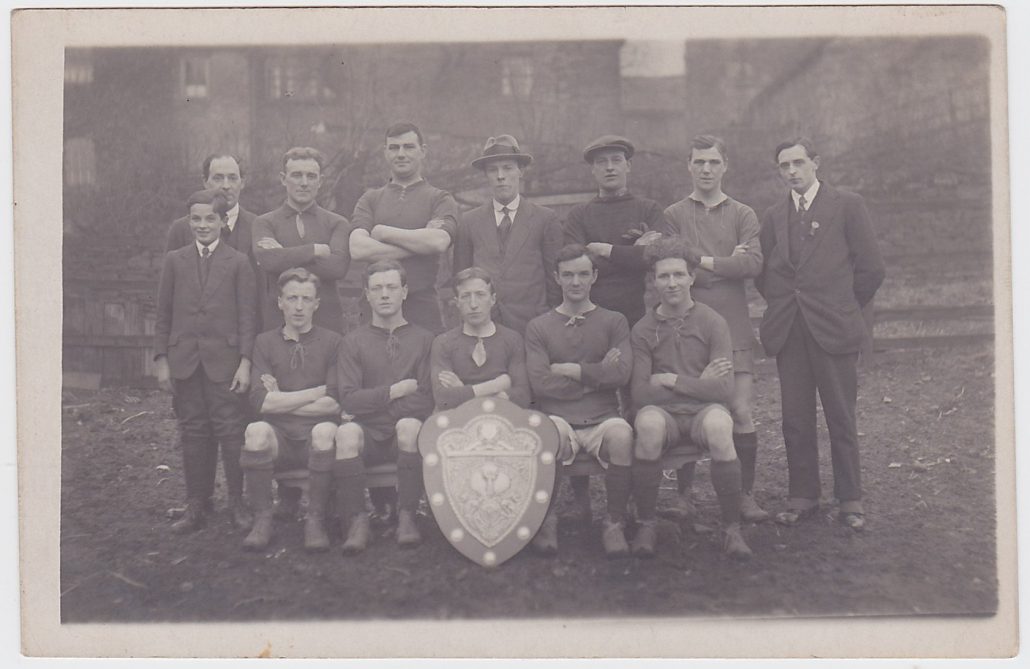
Kildwick Old Boys football team, 1919-20 season
Research carried out by this project has revealed that the photograph is of the 1919-1920 season Kilwick Old Boys football team, which included a number of the Farnhill WW1 Volunteers. The team ended the season, the first after football resumed following WW1, as champions of the Keighley District second division and are shown with the “Victory” shield.
Although the photograph doesn’t have a “cast list” we know from contemporary news reports that the playing members of the team were:
and others whose position on the photograph we don’t know:
The non-playing “officers” of the club included treasurer Eric Green, who appears on the photograph – far right, back row.
So, it’s no longer a total mystery – but if you can help us match more of the players’ names to the faces, please send an email to farnhillww1volunteers@gmail.com
In the early months of the war, before a large number of men were serving in France, the major impact of WW1 locally was the arrival of refugees from Belgium.
Local townships provided homes and jobs for the refugees and contributed substantial funds to refugee charities.
Article – WW1 Belgian refugees in Airedale
On Wednesday 30th August 2017 people taking part in the Farnhill WW1 Volunteers Project gathered for a social evening in Kildwick & Farnhill Institute.
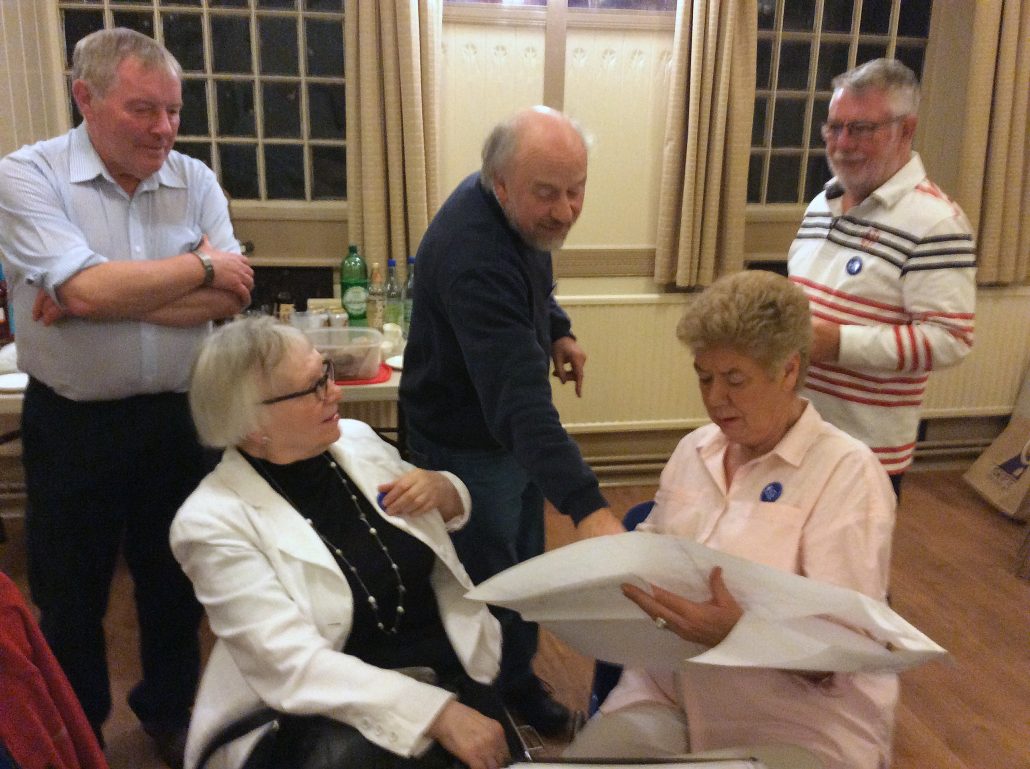
Participants in the project discuss research results
The evening was an opportunity for participants to get to know each other; to provide feedback; to review the progress that has been made in the first eight months of the project; and to consider what needs to be done in the future.
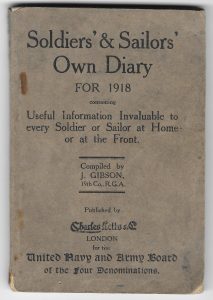
Harry Hargreaves’ 1918 Soldier’s Diary
(Courtesy of Andrew Whittham and Jo Birtwhistle)
Amongst the material made available to the Farnhill WW1 Volunteers project is a 1918 Soldiers’ Diary belonging to Private Harry Hargreaves, of 1/5 battalion West Riding Regiment.
The diary measures about 7 x 11cm – small enough to fit into the pocket of a military uniform; the cover is made of card and the inside pages of very thin paper. The entries were written in pencil, in Harry’s own small (and sometimes, after 100 years, difficult to read) handwriting. All are very concise and include an almost day-by-day account of the weather – even in the days immediately after he had been wounded. It is entirely fitting that the final entry in the diary should be a comment on the weather.
The entries run from January 1st to October 23rd 1918 and record the final months of Harry Hargreaves’ service in France, which began in June 1916.
Article – Harry Hargreaves’ 1918 diary
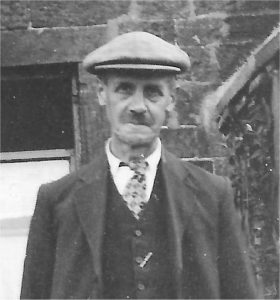
William Benjamin Whitham
(Courtesy of Pauline Pettitt)
William Benjamin Whitham moved to Farnhill, from Haworth, in April 1905. From then until just before his death in 1937 he kept a diary detailing the lives of his family, friends and neighbours; as well as making passing reference to national and international events.
Our article is transcribed and annotated version of William’s diary.
Article – William Whitham’s Farnhill diary
After his release from a German PoW camp at the end of the war, Eric Green, who had served with the Durham Light Infantry, return to Farnhill, where his family ran the butcher’s shop in Main Street.
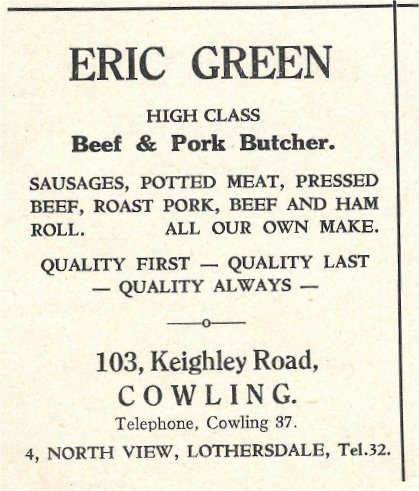
Eric married local girl Annie Mosley in 1919, at Farnhill Chapel; and in 1924 he, Annie, and their young daughter Madge, left the village and moved to Cowling, where Eric set up his own butcher’s shop.
Here’s the advertisement Eric put in Kildwick Parish Magazine in January 1938.
If you would like to help us research more about the Farnhill Volunteers and their families, please contact us.
As we continue to research the families of the Farnhill WW1 Volunteers we are coming across little snippets of information that are sometimes quite surprising. Here’s just one such item.
On the 26th June 1915 (it was a Saturday) Thomas Beckwith Spencer of Oakbank Farnhill married Louise Johenna Fredericka Dorothy Hirth, originally of London, in Kildwick Church. He was a soldier, aged 32; she was 25 and didn’t give a profession. They probably met through her twin brother, as he and Thomas Spencer were lodging in the same house in Leicester at the time of the 1911 census. But what is so remarkable about all this (apart from the fact that it shows how marvellous the project’s researchers are) ?
Well, both of Dora’s parents were German. Yes, that’s right: in the middle of the war Thomas Spencer married a German !
If you would like to help us research more about the Farnhill Volunteers and their families, please contact us.
On Tuesday afternoon, a group of participants in the Farnhill WW1 Volunteers Project attended an Ancestry familiarisation session at Skipton Library.
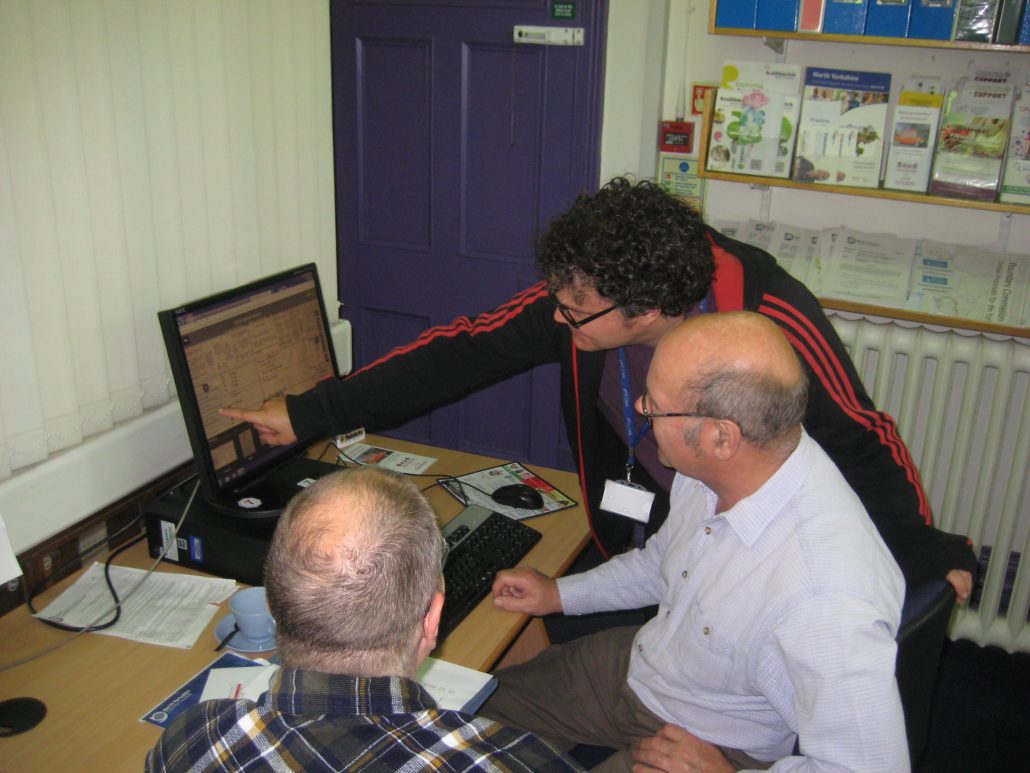
Ancestry training at Skipton Library
Two of the project participants with John Frankland the course tutor
The library was opened especially for us and we had a fine time getting to grips with the Ancestry software, particularly finding out how to use it to discover details of men who fought in WW1.
The experience gained will help us gather material on the Farnhill WW1 Volunteers.
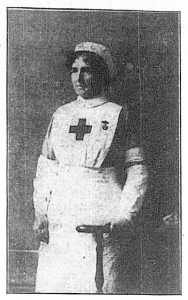
Mary Sharpe as a Red Cross nurse
(courtesy of Keighley News)
Mary Sharpe, who lived at Kildwick Hall, was mayoress of Keighley from 1912 to 1916, when her brother was mayor. Local news reports of the time suggest that she was forthright in her views on a women’s place in society and what women can do in wartime.
Article – Mary Sharpe – a woman’s work